The Ultimate Guide To Colorful Throw Pillows
How to bring a little whimsy (and a lot of color) to your couch
This guide shares how we add color and charm to our house with throw pillows, including all the practical stuff, like sizes and inserts.
This post contains affiliate links. If you buy through them, we may earn a small commission at no extra cost to you.
Start here
The quick answers to the questions we get most.
What size pillow should I get?
Ultimately it depends on the use and the size of your furniture, but about 20″ is typically safe if you are browsing online. For a layered look, pair two sizes that are 2″ apart.
Do pillows come with an insert?
Not always! Check the listing. If it’s cover-only, size the insert 1–2″ bigger than the cover.
Do they have to match?
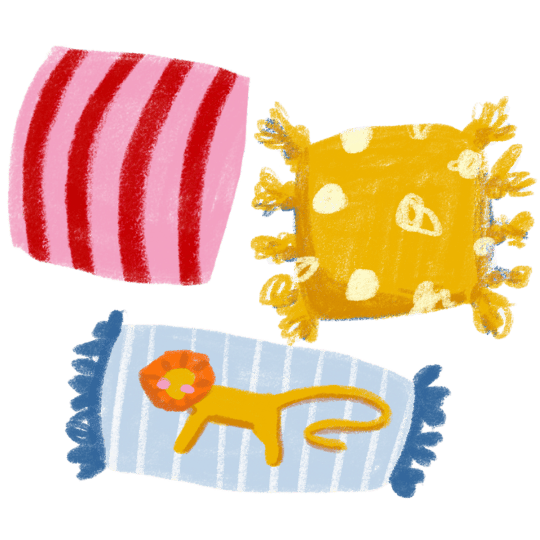
You can use several patterns, as long as they share colors and mix up the print size and type.
Jump to a section
Throw Pillow 101
(everything I wish I’d known)
I remember the first time I properly browsed throw pillows. I didn’t realize there were so many different sizes, or that some came with an insert and others didn’t.
I just wanted someone to tell me exactly how many I needed, which sizes, where to buy them and how to style them…
Oh hey, here we are! Here’s that guide.
Over the years I’ve figured it all out, and the good news is that it’s easier than it may seem at first. I’ve broken it down one step at a time in this guide, including the one “rule” I’m so glad I broke!
First we’ll chat pillow sizes, and then we’ll go from there.
Pillow sizes, decoded
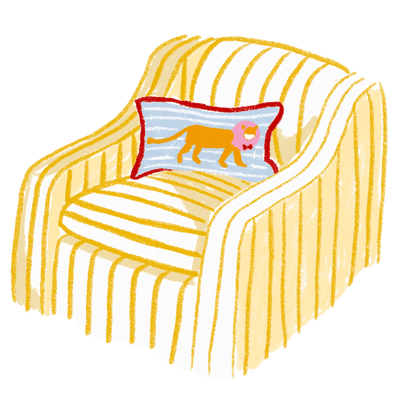
18×18
Small couches, chairs and accent pillows.
20×20
The most versatile size. It works almost anywhere.
22×22
Statement pillows and bigger sofas.
Lumbar
12×20 or 14×24. Layered in front, and great on beds too.
Start with your couch. A couch with a high back can handle bigger pillows, like 22″ and even 24″. A low-profile couch looks best with smaller ones, around 18″ or 20″, so they don’t tower over the back. Measure your couch!
Shopping in centimeters? Lots of Etsy makers are in the UK and Europe. 45 x 45 cm ≈ 18×18 · 50 x 50 cm ≈ 20×20 · 55 x 55 cm ≈ 22×22 · 30 x 50 cm ≈ 12×20. One inch is about 2.5 cm, so the insert rule still works: go 2–5 cm bigger.
Mix sizes, 2″ apart
I like to mix sizes and style 2 or 3 pillows together: a larger one, then one that’s 2″ smaller, like an 18 and a 20, or a 20 and a 22. Our couch has a medium back, so we stop at 22″.
How many do you need?
(a starting point, not a rule!)
For a sectional, spread them across the sections. On a bed, it depends on how layered you like it.
Covers vs. inserts
(what you’re actually buying)
This one surprised me when I first started pillow shopping! Some pillows come complete, with the cover and insert together. Others, especially handmade covers on Etsy, are cover-only, and you buy the insert separately. Always check the listing before you buy.
A note on price: designer fabrics (like Morris & Co or Thibaut) add up fast. Even on Etsy, a cover in designer fabric can run $100+, and that’s just the cover without the insert! The price also goes up with each size, so a 22″ costs more than an 18″. Mixing in a few budget-friendly pillows keeps the whole set from adding up.
Size up: your insert should be 1–2″ bigger than your cover. Don’t worry, the pillow won’t end up bigger! An 18″ cover with a 20″ insert is still about an 18″ pillow, just a fuller one with no saggy corners.
Where to buy: Amazon is our go-to. They’re affordable, fast and come in every size (here are a couple of options: option 1 · option 2). Local shops like HomeGoods or Marshalls have them too.
Look for the add-on: lots of Etsy shops let you add an insert right on the listing (usually a dropdown like “Cover only” or “Cover + insert”). It’s the easiest option, since it’s already sized to fit. Just check the price and the fill. Sometimes it costs more than buying your own, and it might be down alternative or feather.
The reuse trick: have a pillow whose cover you don’t love? Pull out the insert and use it in a new cover. No need to buy a whole new pillow just for the stuffing!
Feather down vs. down alternative
(what’s inside the insert)
Feather down
A mix of feathers and down, the soft fluff under a duck or goose’s feathers. The feathers give it weight and support, and the down makes it soft. Most throw pillow inserts are mostly feathers with a little down. The more down, the softer (and pricier) it gets.
Down alternative
No animal products. It’s made from polyester, cotton or other materials designed to feel like down. A good pick if you’d rather skip feathers. Lots of people swear by these down alternative inserts!
Heads up: don’t be surprised when your inserts come flat packed and vacuum sealed. They’ll fluff up!
Mixing & Matching Pillows
(spoiler: there are no rules!)
The rule I finally broke
One of my favorite ways to bring color into a room is with the little things: coffee table books, candles and, yes, throw pillows. Earlier this year I felt like ours were all a little too muted in the living room, so I set out to find some bolder ones for the couch.
I’ve always heard you should have a mix of solids and patterns, so that’s where I started. I was finding so many colorful and fun patterns, but I just kept running into dead ends with the solids.
They just all felt like too much color in one spot. I didn’t love any of them and I felt like I was forcing myself to settle on one just because I “needed” a solid.
Then I realized I was following a random rule. I didn’t need solids at all. Instead I could just make a set of pillows where every single one brought me joy!
Our couch is now 100% patterns, and it works because they’re all tied together. I’ll walk you through it!
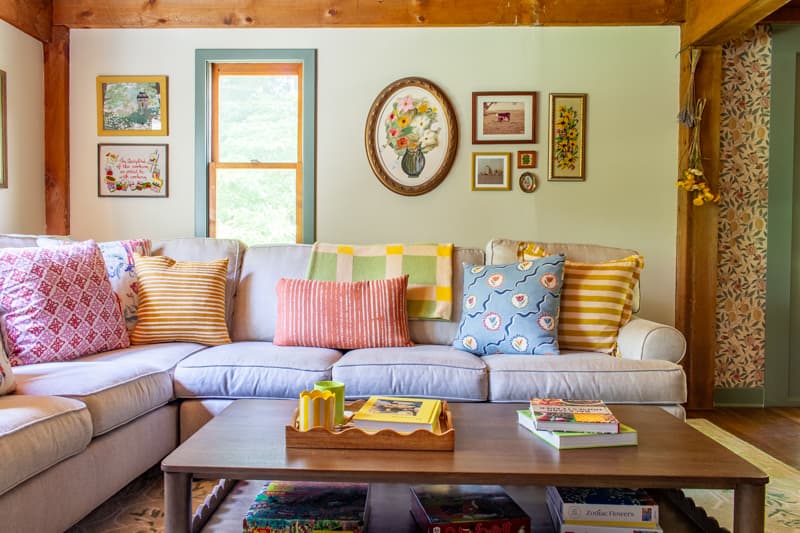
All patterns, all tied together with color.
How to make all-pattern pillows work
Tie them together with color.
Every pillow should speak the same color language. Start with your couch color, or whatever the pillows are sitting on, and then pull in the colors you want to work with (this is your color palette!)
Vary the size of the print.
Pair a big, bold print with a smaller one so they don’t compete.
Mix up the type of pattern.
A stripe, a floral, a gingham, a geometric… different kinds of patterns play together better than two of the same.
Want to learn how to build your own color palette? That’s exactly what we teach inside Color School!
Patterns that play well together
(there’s a method to the madness!)
Mixing patterns is where most people get stuck. You know the look you want, but when you’re staring at two pillows, it’s hard to tell if they go together. I like to keep things really easy and use the same patterns and same few steps every time.
Know your patterns
(every pattern has a job!)
Stripes
Simple and classic, a stripe goes with almost anything. That’s why I like to start with them!
Florals
This is where a lot of color can live. It’s typically a bigger & bolder print at our house compared to the others.
Geometrics
Squiggles, dots and dashes add a fun, modern twist, and they look great in just one color.
Gingham & checks
Small, tidy and playful. They add pattern without competing with the star.
How to mix patterns, step by step
(your pattern map!)
Start with a stripe
Stripes are such a fun way to bring in color, and they’re all over our house: the yellow chairs in our entryway, our duvet and more than one couch pillow! They’re also the easiest pattern to build around. Already have a pillow you love? Start there!
Add a large print
A floral is my go-to. Look for one that shares a color with your stripe. That’s your common thread.
Add a smaller pattern
A gingham, check or geometric that pulls in another color from the set.
Put them side by side
Do you still love it all? If not, keep the one you love most and swap the other.
Give yourself time to play! Plan to spend a while hunting for pillows you love and trying them together. It rarely comes together in one shopping trip, and that’s half the fun.
A few combos I love
Stripe + gingham
Both are simple, so it’s a great place to start. Pair a wide stripe with a small check so they’re different sizes.
Stripe + floral
The floral brings the color, and the stripe calms it down. Pick a stripe in one of the floral’s colors, like the red stripe next to our red & pink pattern pillow.
Stripe + geometric
Two simpler patterns that feel fresh together. Put them in different colors from your palette, like our red stripe and green geometric pillows!
Compare before you buy
(the trick that saves me every time)
When you’re shopping, don’t buy one pillow at a time and hope it works. Put everything you’re considering into Canva (or any design program), side by side, next to a photo of your couch. You’ll see right away what’s working, and what only looked good on its own product page.
Our Couch
(all patterns, no solids, and it works!)
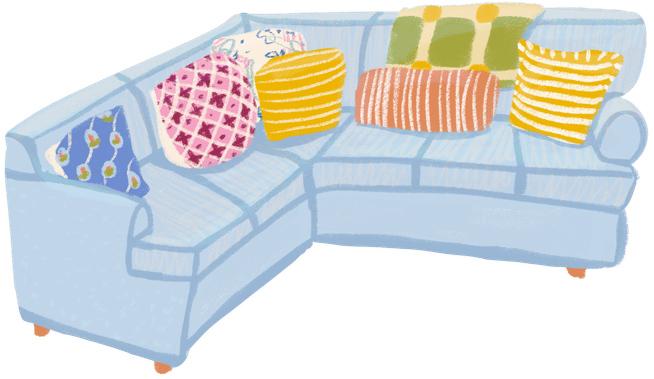
Here’s how it all comes together on our couch. Every pillow is a pattern, but they all pull from the same palette, so it feels collected instead of chaotic.
Look for the colors that repeat: the reds, pinks and green show up again and again.

The breakdown
(a few of our favorites from the couch. We have about 8 in rotation!)
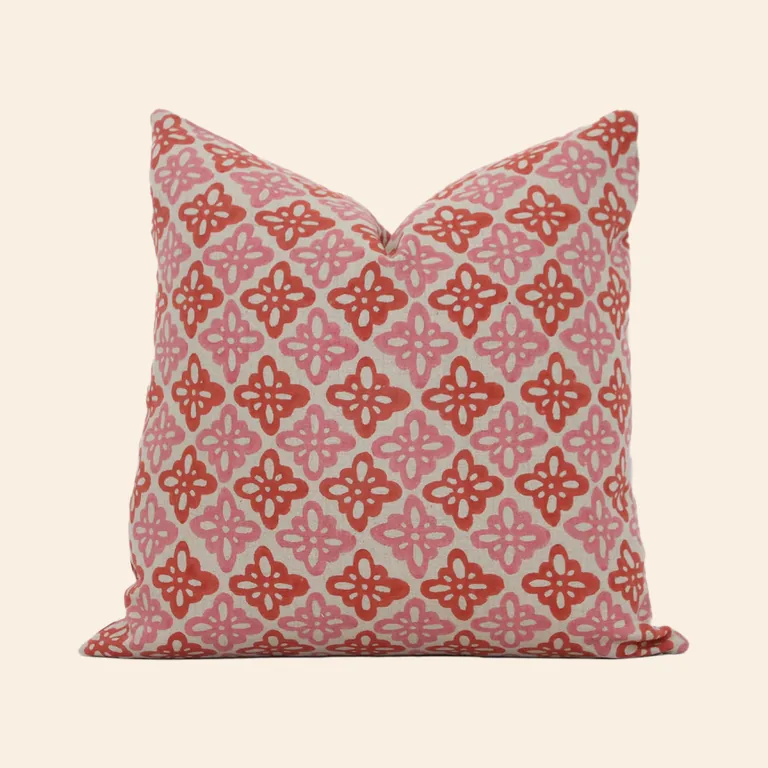
Molly Mahon floral
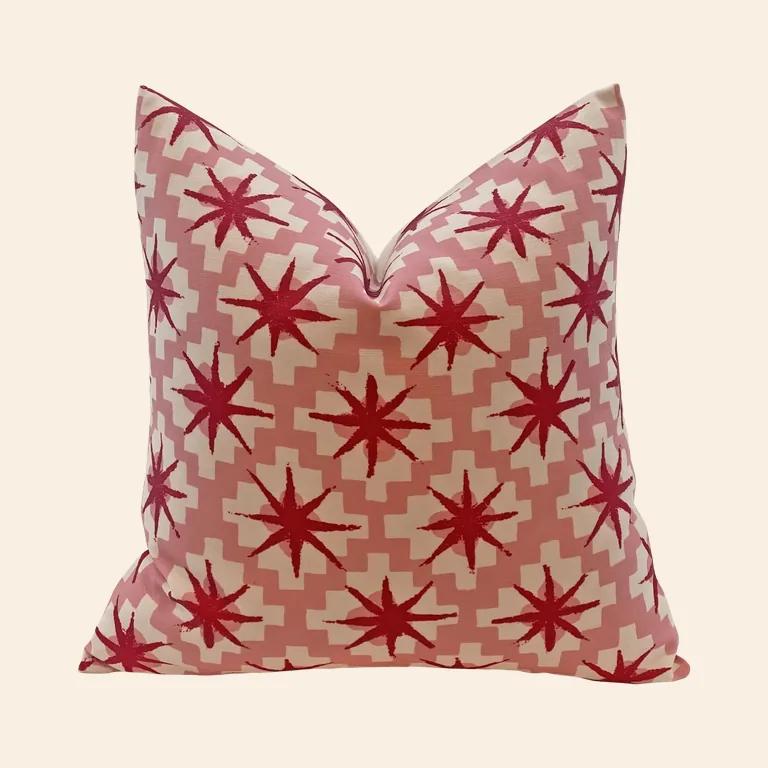
Lots of pinks and reds on a neutral background. I loved the idea of leaning into red and pink because it’s fun any time of year and then reads as festive during the holidays.
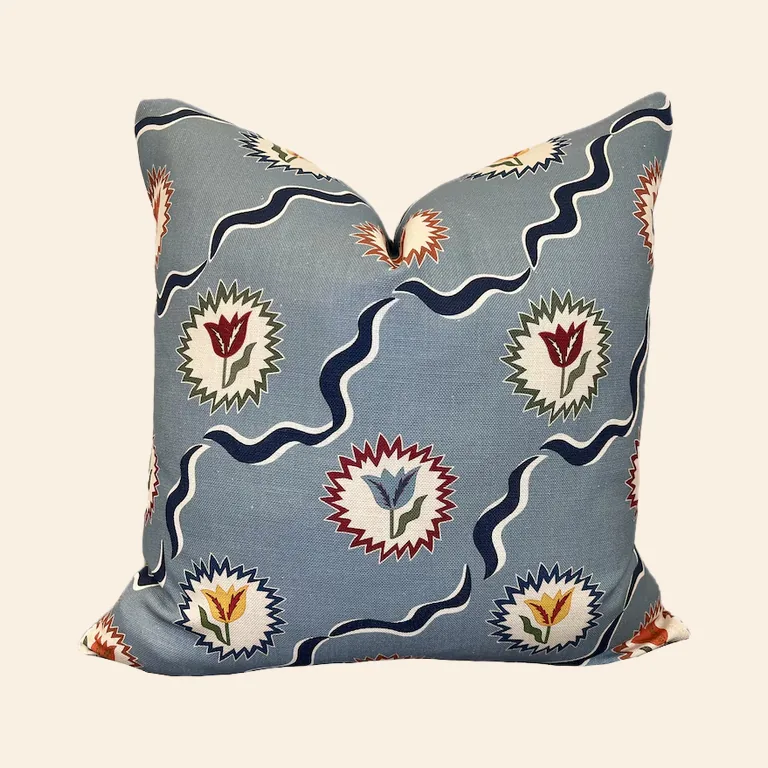
Tulips
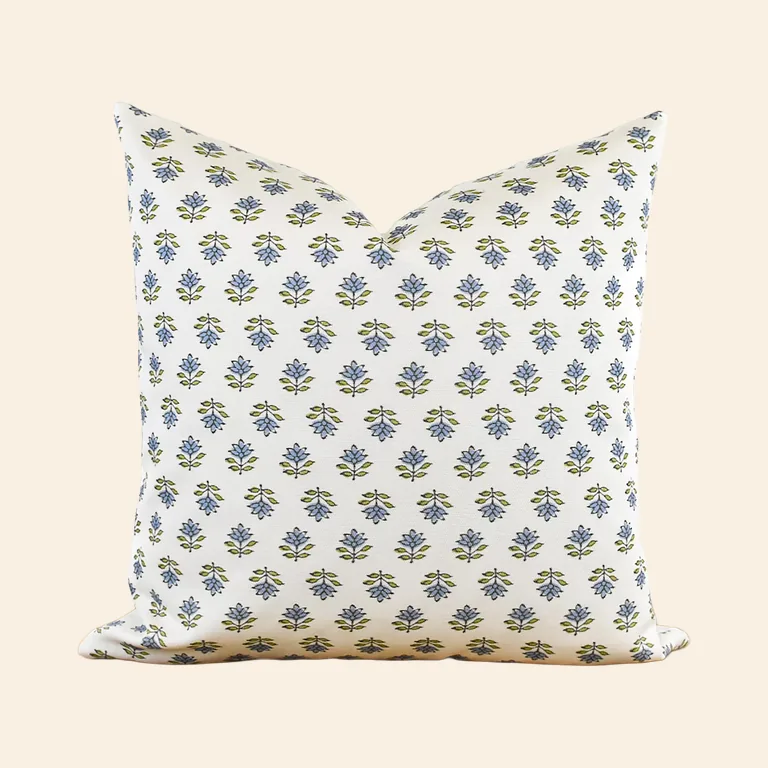
A blue background with red and pink tulips and green stems. The bridge! And it’s WAY PRETTIER in person. Proof that product photos don’t always do a pillow justice!
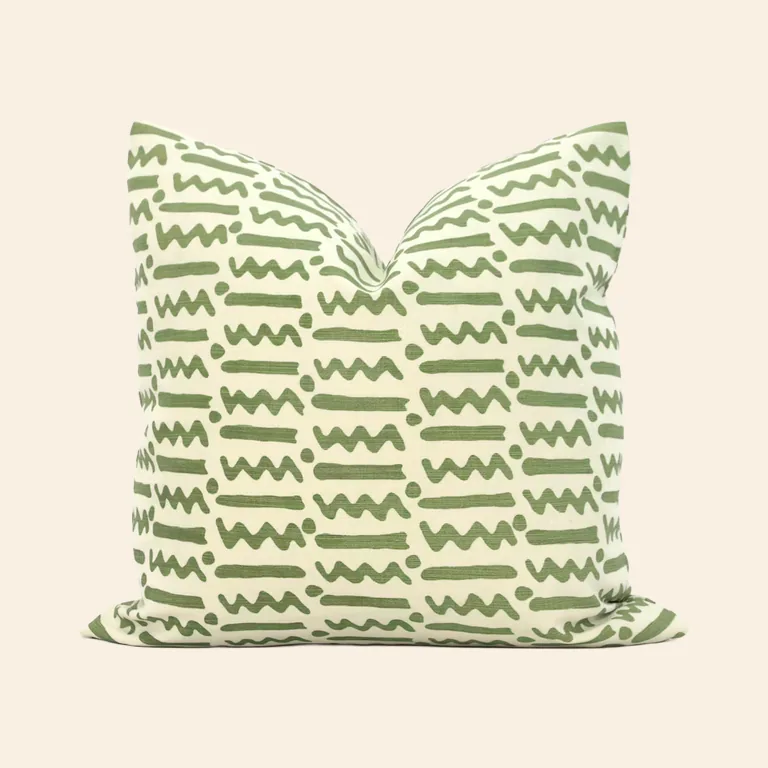
Quadrille green geometric
Just green, on a neutral background. Squiggles and dashes! I also considered using orange but liked that green was in the tulip pillow.

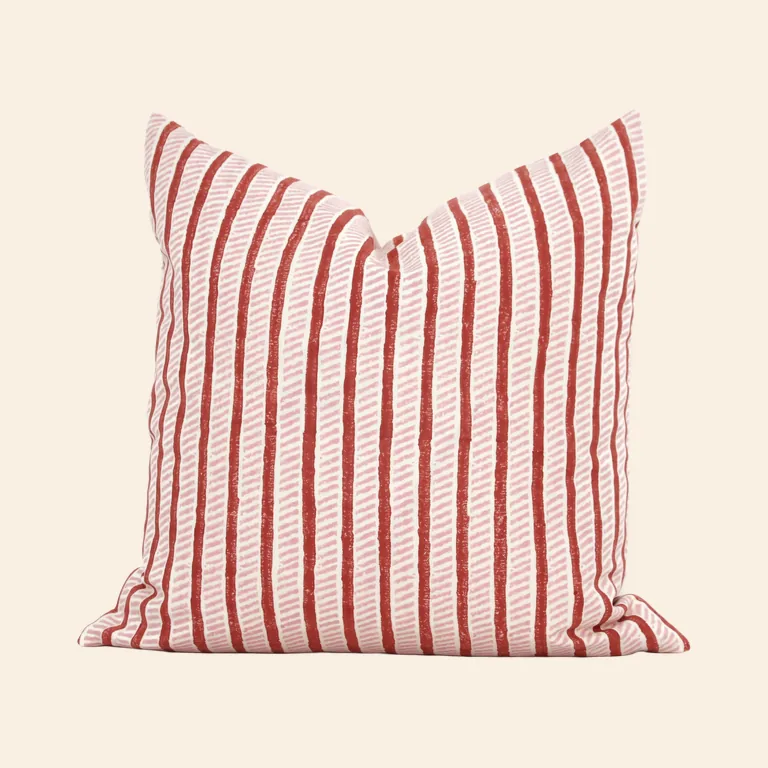
Anthropologie linen blend stripe
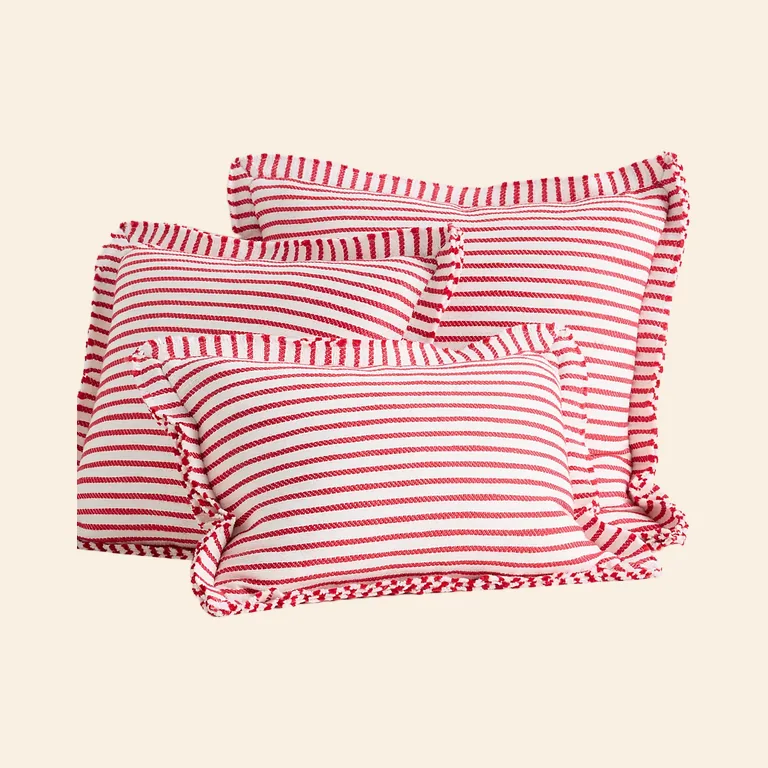
Red and neutral stripes, which pick up the reds in the Molly Mahon and tulip pillows. It comes with an insert, which is a bit floppy compared to some stiffer pillows.
One pillow ties it all together
The Molly Mahon floral is all pinks and reds, and the geometric pillow is just green. They look great together on their own, but the tulip pillow is what really connects them. It has the same pinks and reds as the Molly Mahon, plus green stems that match the geometric, so it bridges the two.
And because every pillow shares at least one color with another, we can mix and match them in small pairs or use them all at once.
Try it: look for a “bridge” pillow that has a little of every color in your mix.
The print sizes vary: big, medium and small.
Lots of different pattern types: a stripe, a geometric and two florals that look totally different.
The sizes are mixed (a bigger pillow paired with a smaller one), so it looks layered.
Pillows In Our Home
(and pillows we love!)


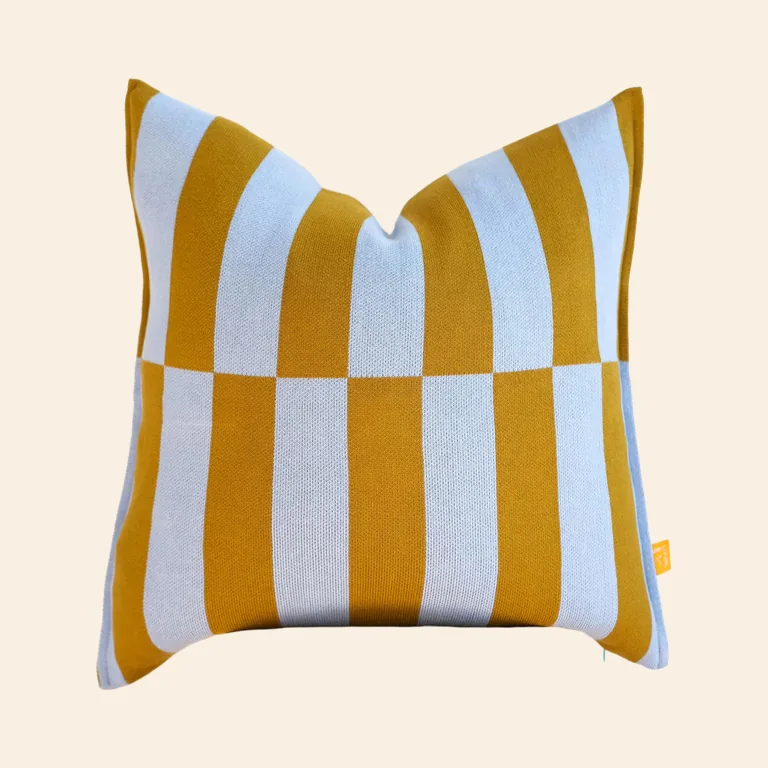
More Pillows We Love
(we haven’t tried these yet, but we’d happily bring them home!)


Where We Love To Shop For Pillows
(and what each one is best for)
Etsy is where most of our pillows come from. You’ll find handmade covers in so many patterns and colors (most are cover-only, but many let you add an insert at checkout!). A few makers we love:
Popocolor
I love all of her fabrics! They’re all designer prints in gorgeous patterns and colors.
Budget tip: order the print on just the front, with a plain neutral on the back.
Muse Textiles
Very vibrant, hand-printed pillows. My first set of colorful pillows came from her shop!
Belle’s Mill
Lovely patterns that are a little less colorful than the others. Perfect if you want to tone it down a bit.
Other Shops
Anthropologie
Great stripes and patterns. Our red stripe pillow is from here!
Amazon (Inserts)
Our go-to for inserts. Affordable, fast and every size.
HomeGoods / Marshalls
Inserts and budget-friendly finds. Always worth a look!
No Rules, Color Matters & Joy Wins
There’s no perfect formula for throw pillows. Pick the patterns you love, tie them together with color, and mix up the sizes. If it makes you happy every time you sit down, you did it right!