
Lesson 3: Room By Room
I’m going to walk you through the five steps I use every time I transform a room– starting with the one piece that makes every other decision easier, all the way through to the final details that make it feel finished and completely yours.
Pick a room. Any room. Let’s go!

A colorful home, one Wall at a time
This guide will show you how to add color to your home one step at a time, starting with a single space. We’ll cover how to find inspiration, create a simple color palette, and use it to transform your space with confidence and ease.
Wondering about something specific you have seen in our house? Check out our sources page— we have most rooms on there! And let me know if we are missing one that you’d like to see!
You have permission to pick what you love
I wrote this guide because I was once exactly where you are now.
When we first moved in, I was absolutely stuck. I felt so embarrassed and overwhelmed, watching everyone else effortlessly create beautiful homes and wondering what I was missing.
I’m not exactly sure when my mindset shifted, but I do know who started it. One day, my four-year-old looked at the colorful upstairs and then at our plain living room and asked, “Could our living room be colorful, too?”
It was the most innocent and direct encouragement I could have asked for, and it was exactly the push I needed to begin.
Off I went. I bought two colorful throw pillows from a local shop, and it was a domino effect.
The pillows sparked so much joy that I finally gave myself permission to decorate based on what I loved, not what was trending.
I spent about a year dreaming up a plan before I made a single change. I had this idea to create a simple color palette, but when I tried to follow the standard “three-color rule,” it just didn’t feel right.
So I threw out the rulebook and decided my home needed five (or more!) colors. The result was a process that brought my home to life, and I’m so excited to finally share it with you.
My 5 Step Process
Step 1
Start Small
If you follow me on Instagram, you’ve probably heard me say ‘one wall at a time adds up.’ It’s true! Our home has come together in a series of exactly those little projects.
Focusing on a single, manageable project makes the process feel less daunting and a lot more fun. It’s the easiest way to get started, build confidence, and feel the joy of a finished space.
This idea reminds me of the KonMari Method from The Magic of Tidying Up. The entire process is built on the principle of gathering your belongings by category and keeping only what truly sparks joy. When you’re done, your home is filled with things you love.
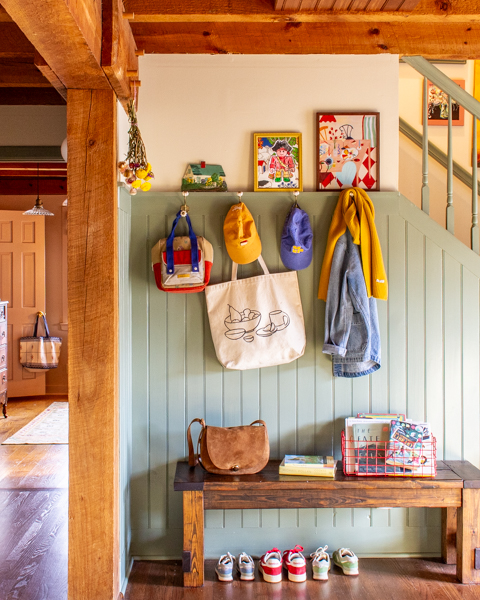
I’ve felt that same spark when passing a finished space in our house. The stairway wall is a good example– we added beadboard, hung some art, and put up hooks for jackets, and suddenly the whole area felt like someone actually lived there.
It was proof of life. That one wall, finished before anything else around it, made me happy every single time I walked by it.
Not sure where to start?
A great rule of thumb is to choose something that feels fun and manageable. A small, high-impact area will help you build momentum and see results quickly.
Here are a few ideas based on projects we’ve done that made a big difference:
1. Living Room Refresh: A new wall color, a few colorful pillows & some fun coffee table books can transform a space!
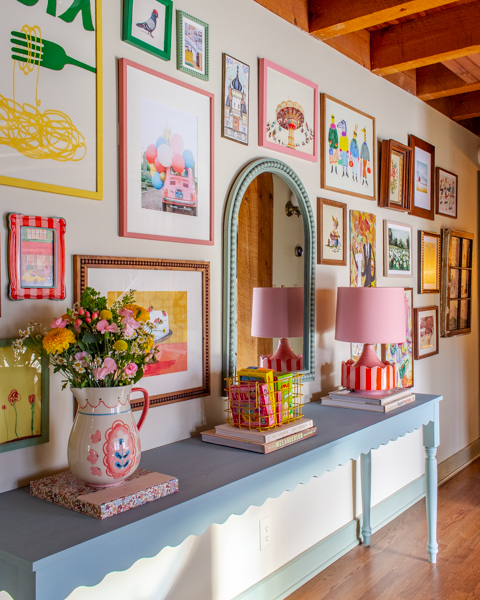
2. Style A Dresser Or Nightstand: Don’t underestimate the power of styling. Swap out your lamp for a colorful one (or paint the base!), stack a few colorful coffee table books, and add a plant. You could also hang or lean some art against the wall for an easy, impactful update.
3. Painted Arch Wall: A painted arch is a simple way to add color and define a space without painting an entire room. We added shelves to ours, but you could also place a favorite piece of furniture in front of it to create a beautiful focal point.
Having a color palette has given me actual confidence. I truly mean it when I say a color palette is the foundation of every design decision I make. It simplifies choices and ensures each element works in the bigger picture.
Step 2
Find your inspiration
Once you’ve chosen your spot, it’s time to find your muse. This is where lesson 1 comes in handy! Pick a single anchor piece that makes you smile.
This can be anything:
- A piece of art that brings joy
- A colorful pillow that catches your eye
- An interesting wallpaper design: Ok, I know that installing wallpaper isn’t a quick project (and definitely not the affordable route!) but you could incorporate a sample of wallpaper by using it as a mat on a picture frame or even framing the wallpaper itself.
- A unique lamp or piece of furniture
- A specific paint color you can’t stop thinking about
Don’t overthink it! Just choose one thing that genuinely inspires you, and then use this piece to build a color palette.
Need a nudge in the right direction?
- If it really is whimsy you’re after, check Etsy for vintage crewel art. I have to actively stop myself from looking daily because I already have too many.
- Use sample pots of Farrow & Ball paint to give your picture frames a new look. I have also been known to paint lamp bases with their small pots. If you are feeling wild, paint a lampshade and then let me know how it goes!
- Whistle Pig is one of my favorite whimsical artists. Message her on Instagram to see what she has available– she’s always quick to get back to you and is open to custom requests!
- Big Night Shop has the most perfect home decor. It’s especially good if olives & tomatoes are on your vision board.
- Speaking of Big Night, their cookbook can definitely be a coffee table book. And you should also pull recipes from it because it’s fantastic. Try the party mix!
- I love Muse Textiles’ colorful pillows! They are one of the first pieces I bought when I started to lean into colorful home decor. Very saturated colors!

Step 3
Build a color palette
Once you have your anchor piece, you can start pulling colors from it to guide your choices for other elements in the room, like textiles, other decor, and even the wall color itself. It’s an easy way to create a room that feels intentional and personal.
This is a good next step because my number one advice for a cohesive interior design is to pick a handful of colors you love and use them as a consistent palette throughout your home.
Groundbreaking, I know.
But hear me out– I think it’s easy to get carried away when adding color. You start buying colorful pieces without thinking about a color scheme. Color for the sake of adding color. And then… whoops! You have a collection of colorful pieces that feel disjointed.
Instead, start by choosing a curated color scheme. It can be super colorful, but by rooting all of your decorating decisions in this single scheme, you’ll find it much easier to create a home that feels intentional and harmonious.
Here’s the color palette I use for our downstairs.







These are the colors I repeat over and over in each room. Truly. Especially Card Room Green– it’s the color of our kitchen cabinets, our fireplace brick, the entryway wall where the backpacks hang and even a mirror in our entryway.
I also use India Yellow in several places as well. You’ll find small touches all over the house, and it’s the star in the dining room.
One important note: make sure to include a neutral in your palette!
We have two whites on ours! I use Off White when it’s with the Card Room Green trim, and Matchstick if it’s with India Yellow.
Want to see this in action?
This guide gives you the steps, but in the membership, I show you the real application– room by room. You’ll see exactly how I use color palettes, where I splurge vs. save, what mistakes I made, and how to edit when something doesn’t work.
Learn moreStep 4
Paint your space
Once you have your color palette, you’ll need to decide how to use color in the room. While a “color drench”– where you paint the walls, trim, and ceiling all the same color– can be stunning, it’s a big commitment.
My Advice For Wall Colors
For an easier and more flexible approach, consider this: Use a neutral color on your walls and a bold, contrasting color on your trim.
This strategy allows you to:
- Add a pop of personality without overpowering the room
- Define architectural features like doorways, windows, or baseboards
- Highlight key areas
We’ve done this several places around our home, including a kid bedroom and the living room.


Step 5
Layer in the colors
With your walls and trim set, you can continue to build on your color palette with smaller decor items. This is the low-stakes, high-fun part, and it makes it easy to swap things out whenever you want a change.
A great approach is to focus on one color at a time. Look for art, pillows, candles, coffee table books, or any piece of decor that’s close to the color you want to add. You can always paint something like a picture frame to bring a color in.
After you’ve added a few colors, keep going! Add a fourth, then a fifth. A patterned throw pillow that combines several of your palette colors is a great way to do this– it does double duty and feels very intentional.
Here’s a fun bonus: if you use the same color palette throughout your home, you can easily move things around from room to room. It’s really fun when you realize that everything works together (but not in a matchy-matchy way, of course!)